morluto/rea
Reverse engineer anything with agents, from app behavior down to native binaries.
README
Tiếng Anh · 简体中文 · 繁體中文 · 日本語 · 한국어 · Türkçe · Русский · Tiếng Việt · ไทย · tiếng Đức · tiếng Tây Ban Nha · người Pháp · Українська · Tiếng Ba Lan · Người Bồ Đào Nha (Brasil) · العربية · فارسی · Tiếng Bahasa Indonesia · tiếng Ý · Ελληνικά · മലയാളം · Roman Urdu · Româna · Български
REA: Reverse Engineer Anything
One MCP for reverse engineering across binaries, applications, and runtime behavior.
See a feature you like. Understand how it works, down to the binary level.





Trang web · Hướng dẫn · Showcases

Bắt đầu nhanh · Showcases · How REA works · What you can analyze · Build RL environments · Câu hỏi thường gặp · Tài liệu
npx rea-agents setup
[!IMPORTANT] Get REA from morluto/rea, rea.tools, hoặc rea-agents npm package. Follow the installation and release links from these official sources. A similar repository name or copied README does not establish that a download is official.


See a feature in an app that you want in your own product? Ask your agent to investigate it with REA. It can inspect the app without its source code, explain how the feature works, show the evidence, and build a version for your project.
REA connects your agent to tools for inspecting native binaries, JavaScript and Electron apps, .NET assemblies, and websites. You can also use the same tools from your terminal. Analysis runs locally, and results include the evidence and limitations behind each conclusion.
Setup registers REA with your agent and installs matching workflow instructions. Native analysis can use an existing Hopper, Ghidra, IDA or Kuna installation; setup can optionally install Hopper with approval. Static JavaScript analysis needs no native analysis engine.
Bắt đầu nhanh
Get started at rea.tools for step-by-step instructions by operating system, agent, and analysis provider.
Connect your agent (MCP)
Với Node.js and npm installed, run this from a trusted directory outside the project you plan to analyze.
npx rea-agents setup
Choose your agent, review and approve the setup plan, then restart your agent. Setup backs up existing configuration and adds REA's MCP connection and investigation skill. See the hướng dẫn cài đặt for supported clients, plugins, manual registration, and troubleshooting.
Try asking your agent:
Understand how search works in the Notes app, show me the evidence, and build a
similar feature for my project.
Replace Notes with your target app and the feature you want to understand.
Use REA from the terminal (CLI)
Inspect an extracted JavaScript/Electron app directory or ASAR:
npx -y rea-agents@latest analyze-javascript-application /absolute/path/to/app --json
The result includes modules, imports, Electron boundaries and their evidence. Replace the path with your target, such as "D:/apps/example" on Windows.
To install the rea command for regular use:
npm install --global rea-agents
rea --help
For native analysis, configure a provider first. The CLI and Evidence guide covers provider selection, native commands, snapshots, and scripting. For Linux prerequisites, see the hướng dẫn cài đặt.
Update REA
For a global npm or Bun installation, run the updater and follow its setup instructions.
rea update
Nếu bạn sử dụng npx, refresh your agent setup with:
npx rea-agents@latest setup
Review the setup changes and restart your agent. See update and uninstall instructions for package runner options and troubleshooting.
Showcases

DX-Ball: reconstruct a sound-pan calculationRecover a position-to-pan helper from x86 instructions and verify the C reconstruction against 3,205 original-x86 cases and all 63 compiled function bytes. Read the case study · Reconstruction repository |
Notion: trace the Electron clipboard bridgeFollow the renderer’s clipboard API through preload and IPC into the main process to see how Notion handles rich clipboard data. Read the case study |
TH04: recover a DOS bullet-ring calculationRecover fixed and aimed angle calculations from the PC-98 game’s 16-bit instructions and compare the reconstructed C++ with historical compiler output. Read the case study · Reconstruction repository |
If you've used REA on something interesting, we'd love to see it. Share your case in an vấn đề hoặc một kéo yêu cầu, including the target, your question, how REA helped, and what you found.
How REA works
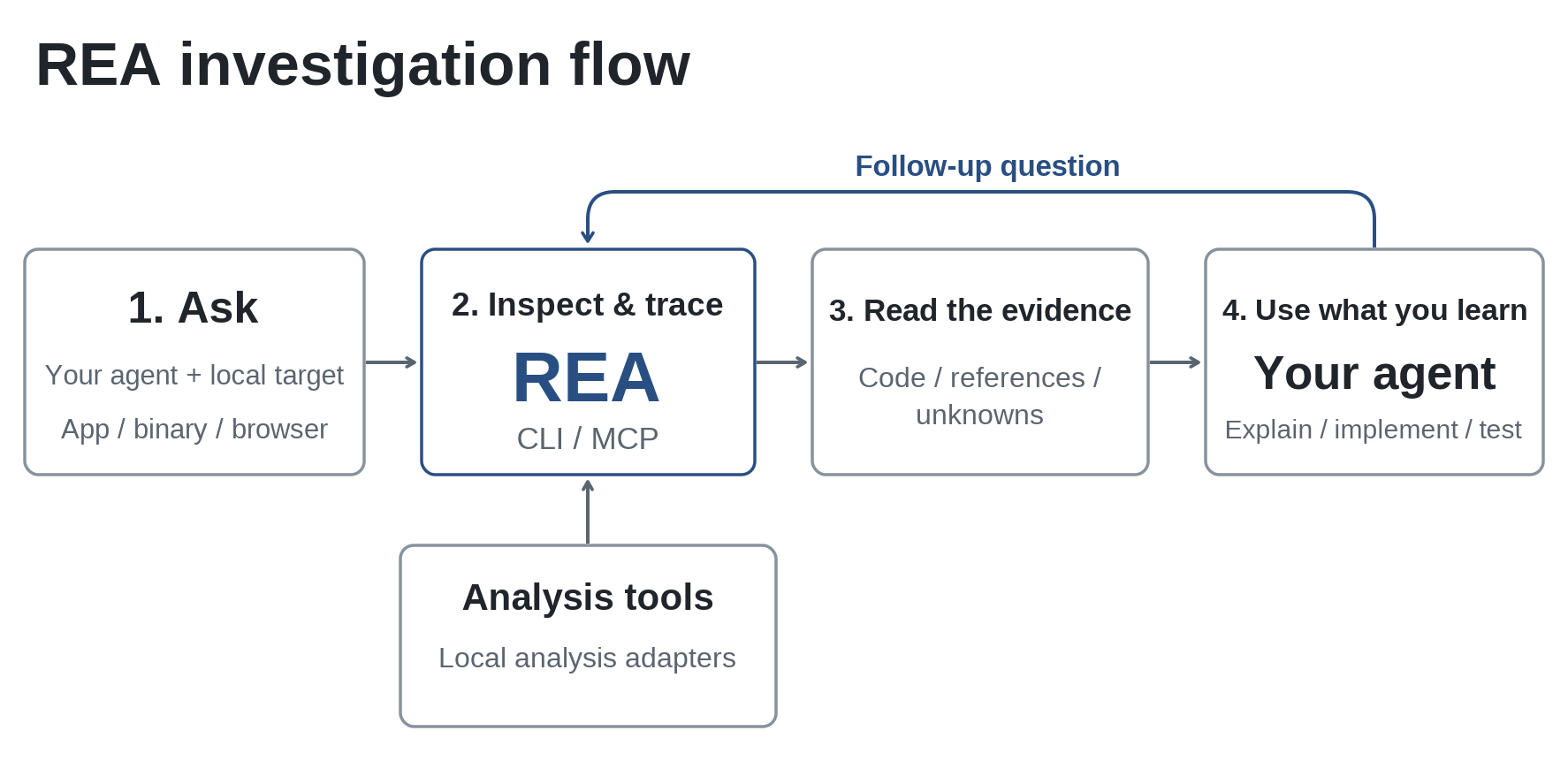
Your agent uses REA through MCP to inspect a target and trace the relevant code. It can use the evidence REA returns to ask follow-up questions, explain behavior, or build and test an implementation. The CLI uses the same workflows.
What you can analyze
REA covers native binaries, JavaScript and Electron apps, websites, .NET assemblies, Android apps, firmware, and recorded runtime and network activity.
Supported targets and requirements
For native decompilation, choose a provider that supports your target format and host OS. See choosing a deep analysis provider.
Build RL environments
Build a local environment from a recorded web session or a Linux desktop app so an agent can practice a task and check its result. Build an RL environment with REA.
Câu hỏi thường gặp
Which agents can use REA?
Any agent that supports local MCP servers. Setup configures the đại lý được hỗ trợ; other clients can use manual MCP registration.
Do I need a native analysis engine?
Deep native analysis uses Hopper, Ghidra, IDA or Kuna, depending on the target and operation. Static JavaScript and .NET inspection work without a native analysis engine. Setup can install Hopper after approval; Ghidra, IDA and Kuna use your existing installations. See provider setup for the options and their supported targets.
Do I need to start Hopper first?
REA starts Hopper when an operation needs it. On macOS, a first-run dialog may ask you to choose demo mode or activate your license. Complete that prompt in the same user session before your first CLI/MCP operation or unattended job. Open Hopper manually if needed. See Hopper startup and troubleshooting.
What does installing the skill from skills.sh do?
The skill supplies investigation instructions for your agent. Use npx rea-agents setup
to register REA's MCP server and install the matching instructions, then restart your agent. See skill-only installation.
What code does REA return?
Native analysis returns pseudocode and assembly. JavaScript/Electron analysis recovers modules and their relationships. Your agent uses these findings to write and test an implementation; the showcases give worked examples.
Does REA upload my app?
REA analyzes targets locally. Your agent receives the tool results, and its model provider has its own data policy.
What should I do if I hit a bug?
Update first; a recent release may already fix it.
For a CLI installed with npm install --global hoặc bun add --global:
rea update
For agent setup through npx:
npx rea-agents@latest setup
If you're using an agent, complete the setup refresh and restart it. Retry the same task. If the problem persists, mở một vấn đề with your REA version, target type, steps to reproduce and error output.
Tài liệu
Start with the website's worked guides. For exact options, prerequisites and result contracts:
- Installation and setup: agent registration, provider configuration, updates and uninstall.
- Readiness and troubleshooting: diagnose one agent or analysis engine.
- CLI and Evidence: commands, provider selection, snapshots, import/export and exit statuses.
- MCP contracts và agent prompts: tool results, sessions and guided investigations.
- Tool catalog: generated inventory of tools, providers and CLI commands.
Report vulnerabilities through BẢO MẬT.md.
Cộng đồng & Hỗ trợ
- Bất hòa — Ask questions and share what you’re investigating with our passionate community of over 50,000 reverse engineers and builders!
- Twitter / X — Follow @reatools for updates and announcements.
- Feedback & Ideas — Want a new feature or support for a file format? Open a GitHub issue hoặc join our Discord and let us know.

Lịch sử sao
🎉 400,000 GitHub stars — thank you!
Thanks to everyone using REA, reporting bugs, requesting features, testing builds, and contributing fixes.

Đóng góp
We'd love your help with REA! Mở một vấn đề to report a bug or suggest a feature, or send a pull request to improve the code or docs.
Xem ĐÓNG GÓP.md for development setup and checks. See the testing guide for verification lanes.
Tuyên bố miễn trừ trách nhiệm
Xem TUYÊN BỐ TỪ CHỐI TRÁCH NHIỆM.md for responsible-use guidance.
The project's position on illegal or unauthorized use covers all REA versions, distribution channels, and platforms; each copy retains its applicable licenses.
REA is for lawful research, education, interoperability, software preservation, and analysis of software you own or are authorized to examine.
Giấy phép
REA-authored code is licensed under MIT. Third-party material retains its own licenses and copyright notices; see Thông báo của bên thứ ba for the dependency inventory, preserved license texts, and external-tool terms.
You must legally obtain and be authorized to use commercial tools, including IDA Pro / Hex-Rays decompilers, Hopper, and JEB, under their applicable licenses. REA grants no tool license, key, or activation entitlement. Trials and demos remain subject to vendor terms, including user, feature, automation, and output sharing restrictions. Cracked copies, stolen keys, unauthorized key sharing, and bypassing license restrictions are not authorized. This guidance does not amend MIT or third-party licenses.
Dự án cùng danh mục

AI thực sự làm được mọi việc. Bất kỳ hệ điều hành nào. Bất kỳ nền tảng nào. Cách tôm hùm. 🦞

Kỹ năng dành cho kỹ sư thực sự. Trực tiếp từ thư mục .agents của tôi.

Hệ thống tối ưu hóa hiệu suất khai thác tác nhân. Kỹ năng, bản năng, trí nhớ, bảo mật và sự phát triển ưu tiên nghiên cứu cho Claude Code, Codex, Opencode, Cursor và hơn thế nữa.

DeepSeek Khai thác: Mọi thứ đều là Plugin.

Đại lý phát triển cùng bạn
