AprilNEA/OpenLogi
⚡️A native, local-first alternative to Logitech Options+, written in Rust 🦀 — remap buttons, DPI, and SmartShift over HID++. No account, no telemetry.
README
[!WARNING] OpenLogi is under active development and not yet stable — features and config may still change. Give the repo a Star ⭐ and Watch 👀 it to get notified when a new release lands.
English | 简体中文 | 日本語 | Deutsch | Français | 한국어

OpenLogi
⚡️ A native, local-first alternative to Logitech Options+, written in Rust 🦀
Unlock the full capabilities of Logitech mice, keyboards, and webcams over HID++ and UVC





Fed up with Options+? Try OpenLogi.
Runs on macOS, Linux, and Windows.
Beyond Options+
Things OpenLogi does that Options+ won't:
- Stay light. Native Rust + GPUI.
- Run on Linux. Linux is a first-class platform in OpenLogi.
- Gestures on any button. Give the gesture role to any physical button — or turn gestures off entirely.
- Plain-text config. Everything is one TOML file you can sync between machines however you like.
- Script it. A real CLI alongside the GUI.
Features
- Devices connected over Logi Bolt receivers, Unifying receivers, Bluetooth, or a wired connection, with battery percentage and charge state
- Button remapping via the OS input hook: a built-in action catalog plus custom keyboard shortcuts authored in the TOML config¹
- Per-application profile overlays that auto-switch on app focus (macOS + Windows; Linux on X11 / XWayland only)
- Litra lights: power, brightness, and color temperature, with optional auto power that follows camera activity
Mouse
- Capture and remap the middle, mode-shift, and thumbwheel buttons (middle everywhere, the rest where the device exposes them)
- Per-direction gesture bindings with live capture, on any capable button
- Actions Ring: a cursor-centred, eight-slot overlay of actions (
ShowActionsRing), with per-application layouts - DPI control with presets and Cycle / Set-preset actions (
0x2201) - SmartShift wheel: mode toggle, sensitivity, and a permanent-ratchet panel (
0x2111) - Per-device native scroll inversion (
0x2121, supported devices)
Keyboard
- Global F-key remapping: the same action catalog as the mouse, plus power-user actions — typed text, key combos, multi-step workflows (macOS + Windows)
- Static RGB lighting (
0x8070/0x8080, supported devices)
Camera
- Any Logitech UVC webcam (Brio, StreamCam, the C920 series, …), plug and play
- Live preview that opens the camera only while you watch — leaving it releases the camera entirely and the LED goes off
- Image controls written straight to the UVC hardware — zoom, focus, exposure, brightness, contrast, saturation, sharpness, white balance, tint, anti-flicker, and low-light compensation, with auto-mode toggles for focus / exposure / white balance — so changes apply in Meet / Zoom / OBS and every other app using the camera
- One-click profiles: built-in Default / Streaming / Video call plus custom snapshots; settings persist per camera and are written back to the hardware on the next view
¹ Media key actions use D-Bus MPRIS on Linux; a handful of macOS-specific actions have no universal Linux equivalent and are no-ops. Windows maps platform actions to native equivalents where available.
Install
[!IMPORTANT] Quit Logi Options+ first: the two applications fight over HID++ access, and only one can own a given receiver at a time.
macOS
Requires macOS 13 or later.
Download the signed, notarized .dmg from the latest release and drag OpenLogi.app to /Applications.
Or install via Homebrew:
brew install --cask openlogi
The official Homebrew cask is the default installation path. To explicitly
track the latest GitHub release from aprilnea/tap instead:
brew tap aprilnea/tap
brew install --cask aprilnea/tap/openlogi@latest
openlogi@latest is maintained by OpenLogi's release workflow and may update
before the official cask autobump lands. Install either openlogi or
openlogi@latest, not both.
Linux
Download the package for your distribution from the latest release:
# Debian / Ubuntu
sudo dpkg -i openlogi_*.deb

# Fedora / RHEL
sudo rpm -i openlogi-*.rpm

# Arch Linux
sudo pacman -U openlogi-*.pkg.tar.zst
Packages are published for both x86_64/amd64 and arm64/aarch64.
Pre-built packages require GLIBC 2.35 or newer (Ubuntu 22.04 baseline).
NixOS users can instead import the repository's module, which installs the package and udev rules and starts the agent with the graphical session:
{
  inputs.nixpkgs.url = "github:NixOS/nixpkgs/nixos-unstable";
  inputs.openlogi = {
    url = "github:AprilNEA/OpenLogi";
    inputs.nixpkgs.follows = "nixpkgs";
  };

  outputs = { nixpkgs, openlogi, ... }: {
    nixosConfigurations.my-host = nixpkgs.lib.nixosSystem {
      system = "x86_64-linux"; # or aarch64-linux
      modules = [
        openlogi.nixosModules.default
        { programs.openlogi.enable = true; }
      ];
    };
  };
}
All Linux packages install udev rules that grant your user access to
/dev/hidraw*, /dev/uinput and your Logitech mouse's /dev/input/event*
node without sudo. The NixOS module starts the agent automatically; after a
.deb, .rpm, or .pkg.tar.zst installation, enable it for your user:
systemctl --user enable --now openlogi-agent.service
See docs/INSTALL-linux.md for complete NixOS options, manual / source installs, and distros without systemd.
Windows
Signed portable .zip archives and per-user .msi installers (x86_64 and
arm64) are attached to each release. Both ship the GUI (OpenLogi.exe)
together with the background agent (openlogi-agent.exe), which owns all
device I/O. Keep the two files side by side when using the portable zip, or
the GUI has nothing to connect to.
Windows support has been validated end-to-end on Windows 11 with real
hardware (a wired keyboard and a Unifying-receiver mouse), including
install, in-place upgrade, and uninstall of the MSI. It is newer than the
macOS build, so if you hit a rough edge please
report it. The agent shows a
system-tray icon (Show Main Window / Quit) so the app stays reachable after
the main window is closed. To disable it on Windows, set
show_in_menu_bar = false in the TOML [app_settings] block and restart the
agent; the GUI toggle is currently macOS-only.
To build from source, see DEVELOPMENT.md.
Usage (CLI)
See USAGE.md
Configuration
See CONFIGURATION.md
Developing
See DEVELOPMENT.md
Acknowledgments
- Windows, cameras, and i18n by @davidbudnick — keyboard RGB, Windows support, Logitech webcam support
- Linux port by @cserby — Linux support
- Solaar by @pwr — open-source HID++ implementation
- Mouser by @TomBadash — a local, account-free Options+ replacement
License
The code in this repository is dual-licensed under either of
- Apache License, Version 2.0 (LICENSE-APACHE)
- MIT license (LICENSE-MIT)
at your option.
Third-party code
crates/openlogi-hidpp is a vendored fork of hidpp
by @lus, licensed 0BSD.
Logo & brand assets
Thanks to @kubai087 for designing the OpenLogi
logo. The OpenLogi logo and app icon (the brand assets under
design/) are © 2026 AprilNEA, all rights reserved, and are not covered by the MIT/Apache
licenses above; see design/LICENSE. Forking the code grants
no right to the OpenLogi name, logo, or icon; please don't use them to represent
your own projects, forks, or distributions without prior written permission.
Not affiliated with Logitech. "Logitech", "MX Master", and "Options+" are trademarks of Logitech International S.A.
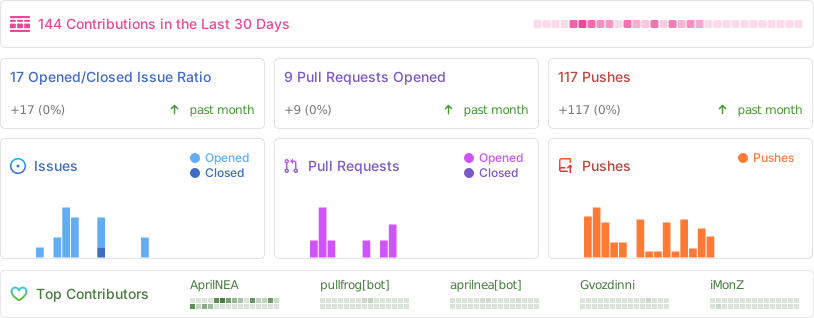
Repo activity
Similar projects

freeCodeCamp.org's open-source codebase and curriculum. Learn math, programming, and computer science for free.

A list of Free Software network services and web applications which can be hosted on your own servers

A modern GUI client based on Tauri, designed to run in Windows, macOS and Linux for tailored proxy experience

Empowering everyone to build reliable and efficient software.

A GUI client for Windows, Linux and macOS, support Xray and sing-box and others

Build smaller, faster, and more secure desktop and mobile applications with a web frontend.